
How Mold Quotes and Remediation Work in Colorado Springs
Colorado Springs Mold Pros is a free quote service, not a mold company. You describe the problem once; independent local mold inspection and remediation companies reply with free, no-obligation quotes. Here is our part, and the steps a professional mold job in the Pikes Peak region typically follows.
Get a Free QuoteOur part: getting you quotes
This site does not inspect, test or remediate anything. The company you choose does the work and contracts with you directly.
You describe the problem
Fill out the free quote form or call. Where you see or smell mold, the rough size, what got wet and when, and the age of the house. Photos help, and nothing has to be exact.
Independent companies reply
Your request goes to local mold inspection and remediation companies that serve your area, from Colorado Springs to Monument, Fountain and Woodland Park. They contact you directly.
You compare and decide
Most companies look before they price. Compare written scopes with the cost guide, hire one or walk away. The quotes are free and there is no obligation.
Before you hire: what to ask
Colorado has no state mold license, so there is no number to look up. The questions you ask carry the weight instead. Ask every company for:
- Training such as IICRC S520 or ACAC credentials, and how many jobs like yours it has done.
- Proof of general liability insurance.
- A written protocol covering containment, removal, the water fix, drying and clearance.
- For a pre-1989 home, whether an asbestos test is needed before tear-out, and who does the sampling. For a pre-1978 home, how lead-safe work rules will be followed.
- Whether the quote includes rebuild, and whether any of it needs a PPRBD permit.
- Who fixes the water: a plumber, a roofer, a licensed mechanical contractor for the swamp cooler or furnace, or a grading and drainage contractor.
- What paperwork you get at the end. Keep it: Colorado sellers must disclose known moisture and water problems, and known mold is a material fact.
We don’t verify any of this. This is general information, not legal advice.
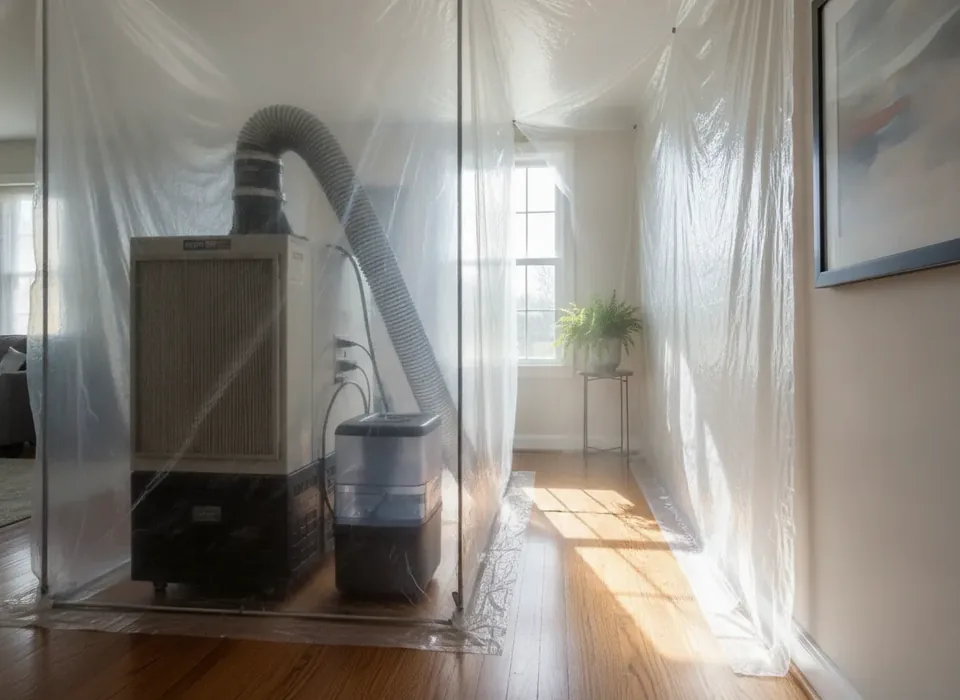
What a mold remediation job typically involves
Every company has its own methods, but most professional jobs follow the same logic in EPA guidance and the IICRC S520 standard: find and fix the water, keep spores contained, remove what can’t be saved, dry what remains, and check the result before the wall goes back. The eight steps below are what you should see in a written scope.
1. Describe the problem once
Use the free quote form or call. Say where the mold is, roughly how big it looks, what got wet and when, whether it is a basement or crawl space, and the age of the house. Photos help. Independent local companies that serve your ZIP code reply with free, no-obligation quotes.
2. Inspection and moisture mapping
The company looks at the area, checks moisture in walls, floors and framing with meters, and traces the water to its source: a window well, a frozen pipe, a roof breach, a swamp cooler line. The EPA says sampling is usually unnecessary when mold is visible, so testing is optional at this stage.
3. Written scope
You get a written protocol: rooms affected, square feet, what gets removed, how the water source will be fixed and by whom, drying targets, how the job will be cleared, and what is in or out, such as rebuild. Compare it with other quotes line by line.
4. Containment and negative air
The work zone is sealed with plastic sheeting and zipper doors, and a negative air machine with HEPA filtration keeps spores from drifting into clean rooms. The EPA says not to run the HVAC system if it may be contaminated.
5. Removal and cleaning
Porous materials with growth, such as drywall, insulation, carpet pad and ceiling tile, are cut out, bagged inside containment and removed. Framing, concrete and other hard surfaces are cleaned and HEPA-vacuumed. In a pre-1989 home, suspect materials should already have been checked for asbestos before this step.
6. Drying
Air movers and dehumidifiers run until moisture readings in the remaining materials are back to normal, which is checked with the same meters used at the start. The EPA’s 24–48 hour window applies to new water; drying a wall that was wet for weeks takes longer.
7. Clearance: visual, then optional testing
Containment comes down only after the area is visibly clean and dry. Some homeowners add a clearance test with air samples from a tester who is not the remediator. Colorado requires post-remediation testing in rentals under the habitability law.
8. Rebuild by a PPRBD-registered contractor
New drywall, insulation, flooring and paint may be the same company or a different one. If the rebuild touches framing, plumbing or electrical, confirm with the Pikes Peak Regional Building Department whether a permit is needed; the company pulling it must be PPRBD-registered.
Health questions? We don’t give medical advice. If anyone in the home has symptoms you think are related to mold, see a doctor.
How long does it take?
A bathroom wall or a window-well leak is often a one- to three-day job once the water is stopped. A finished basement after a burst pipe can run a week or more because drying comes before anything is rebuilt. Add time if an asbestos lab result is pending or if a permit is needed for rebuild. Timelines come from the companies, not from this site; ask each one to put a schedule in the scope.
Small job? You may not need a company
The EPA says a homeowner can usually handle mold covering less than about 10 square feet, provided the water problem is fixed. If the patch keeps coming back, if you smell it but can’t find it, or if the drywall is soft, quotes are free. Common questions are answered on the mold FAQ.
Seeing or smelling mold? Get a clear plan.
Free, no-pressure quotes from independent companies across Colorado Springs, Monument, Fountain, Woodland Park and the Pikes Peak region.