
Basement & Crawl Space Mold Removal in Colorado Springs
Damp foundation walls, musty finished basements and wet crawl spaces are the most common mold requests from Colorado Springs homes. Independent local remediation companies reply with free quotes; this page explains what they look for and what to expect.
Get a Free Quote Call (719) 642-1761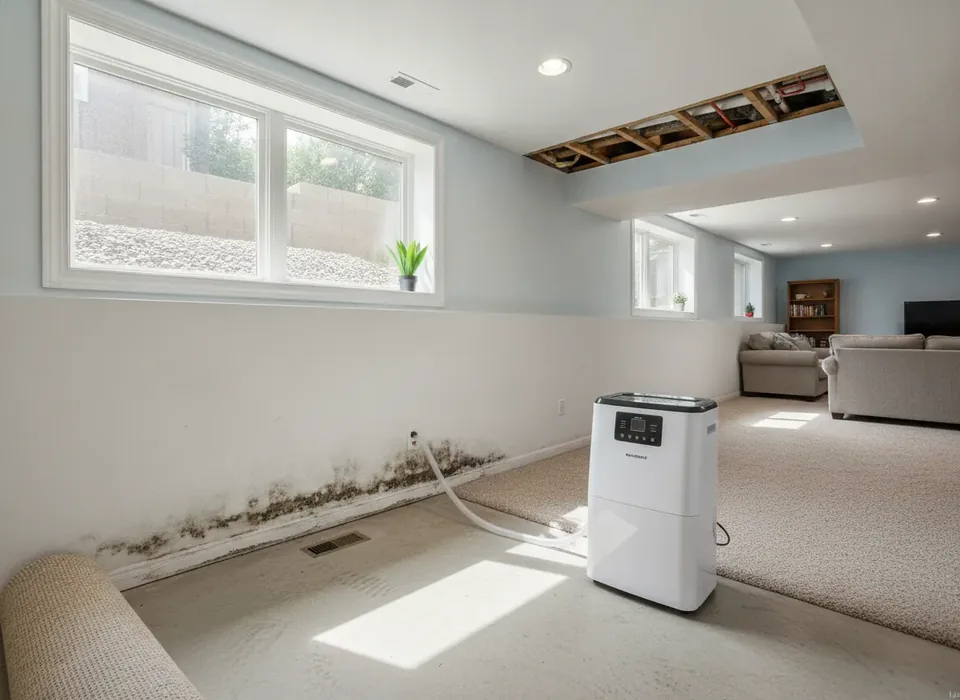
Why the basement is where mold starts here
Roughly a third of Colorado Springs homes have a basement, per industry estimates, and a large share of those are finished. That creates a wall cavity with drywall on one side, concrete on the other and insulation in between. When water comes through the concrete, that cavity stays wet for weeks while the room air above the carpet reads bone dry.
The water gets there in a few familiar ways. March is the snowiest month of the year, and a fast melt into frozen ground runs toward the house instead of into it. Summer brings most of the year's rain in hard bursts that overflow window wells and overwhelm clogged footing drains. El Paso County's expansive clay swells when wet and shrinks when dry, which cracks slabs and walls and opens new paths for water each season.
Crawl spaces have the same problem without the drywall: bare soil, cold concrete, poor air movement and, in older neighborhoods, galvanized plumbing that drips for years before anyone notices.
Signs you are dealing with hidden basement mold
- A musty smell strongest at the bottom of the stairs or in a storage room, with nothing visible.
- Carpet that feels cool or damp along an exterior wall, or baseboard that has swelled or pulled away.
- Efflorescence, the white mineral crust, on exposed concrete: water is moving through the wall.
- Staining on the bottom 12 to 24 inches of drywall, especially below an egress window.
- Dark spots on joists, subfloor or the vapor barrier when you shine a light into the crawl space.
- Allergy symptoms that improve when you leave the house. Mention it to a doctor.
How the companies handle a basement or crawl space job
Find the entry point
Moisture meter on the walls, thermal camera for cold wet zones, a look at grading, downspouts, window well drains and the sump. The scope should name the source, because fixing it is usually a separate trade: a waterproofing contractor, a plumber, or simply regrading and extending downspouts.
Contain and set up negative air
Plastic sheeting isolates the affected rooms from the stairwell and the furnace return, which matters because the air handler is usually down there. A HEPA scrubber runs the whole time.
Remove wet finishes
Carpet and pad, the bottom section of drywall (a "flood cut"), wet insulation and particleboard trim come out and are bagged. In a crawl space, the old vapor barrier and contaminated insulation are removed.
Clean the structure
Concrete, block and framing are HEPA vacuumed, cleaned and sometimes blasted. Framing is rarely replaced unless it has lost strength.
Dry it and prove it
Air movers and a dehumidifier run until framing and slab readings meet a dry standard. Ask to see the readings.
Clearance and rebuild
Visual check and optional sampling, then drywall, trim and flooring. If framing changes or a drain is added, a PPRBD-registered contractor pulls the permit.
Basement and crawl space mold cost
Finished basements cost more than unfinished ones because of what comes out and goes back in.
| Item | Typical range | Source |
|---|---|---|
| Basement | $1,500–$4,000 | Fixr 2025 |
| Crawl space | $500–$2,000 | Fixr 2025 |
| Mold remediation, per sq ft | $10–$25 (avg ≈ $18) | This Old House 2026; Fixr 2025 ($10–$30) |
| Small area ≈ 100 / 200 sq ft | $1,000–$2,500 / $2,000–$5,000 | This Old House 2026 |
| Mold inspection / testing (separate) | $303–$1,044 (avg ≈ $670) | HomeAdvisor 2025 |
Typical published ranges, not quotes (Fixr Aug 2025, This Old House Mar 2026, HomeAdvisor 2025). Colorado Springs quotes come from the companies, not from this site.
Waterproofing, sump pumps, drain tile and encapsulation are separate quotes. Use the cost guide calculator to rough out the remediation portion.
Insurance, sewer lines and asbestos
Groundwater seepage and flooding are excluded on standard homeowners policies, which rules out most spring basement claims. Sewer backup is covered only with an endorsement, and Colorado Springs Utilities' policy puts the service line from the house to the main on the homeowner. If the cause was a burst pipe or failed water heater, you may have coverage up to your mold sublimit; document before cleanup. More in does homeowners insurance cover mold in Colorado.
Basement tear-outs are large. A flood cut around a finished room clears the 32 square foot asbestos trigger level fast, and in homes built before 1989 the drywall texture, joint compound and old flooring may contain asbestos. Ask whether an asbestos test is needed before tear-out. In pre-1978 homes, paid work that disturbs paint falls under EPA lead-safe rules.
One sentence on radon: El Paso County is in the EPA's highest radon zone, the same cracks admit both, and radon is a separate test and a separate trade.
When it is urgent
Standing water in a basement is urgent even if it is clean. The EPA's window for drying before mold takes hold is 24 to 48 hours. Get the water out, pull the carpet pad, run fans, and request quotes the same day. Water from a floor drain or from outside is contaminated; keep kids and pets upstairs. See mold after water, snowmelt and flood damage and the basement mold after snowmelt guide.
Questions to ask the companies
- Where is the water coming from, and will your scope say so?
- Do you handle the waterproofing or drainage fix, or do I need another contractor?
- How far up the wall will you cut, and how did you decide?
- Will you isolate the furnace return during the work?
- What training do your techs hold, and can you send proof of liability insurance?
Finished basements in Briargate, Monument and Falcon make up a large share of these requests.
Get basement and crawl space mold quotes
Tell us whether the basement is finished, where the staining or smell is, and whether you have had standing water, a sump failure or a sewer backup.
Independent local companies reply to you directly. No obligation, and you decide who to hire. Prefer to talk? Call (719) 642-1761
Basement and crawl space mold questions
Why is my Colorado Springs basement moldy when the climate is so dry?
Because the water is coming through the foundation, not out of the air. Spring snowmelt and summer thunderstorms load the soil, window wells overflow, and expansive clay cracks slabs and walls. Finished basements trap that moisture behind drywall and under carpet pad where dry room air never reaches it. The mold grows in the wall cavity, and the first sign is usually the smell.
How much does basement or crawl space mold removal cost?
Fixr's 2025 ranges run $1,500 to $4,000 for a basement and $500 to $2,000 for a crawl space, with per-square-foot pricing of $10 to $25 in This Old House's 2026 data. Finished basements cost more because drywall, insulation and flooring come out and go back in. These are published ranges, not quotes; the companies set local prices.
Will insurance pay for basement mold?
Often not. Groundwater seepage, surface flooding and slow leaks are standard exclusions, and mold sublimits are commonly $1,000 to $10,000 even when a claim is covered. A sudden event such as a burst supply line or a failed water heater is the usual path to coverage. Sewer backup needs its own endorsement. Photograph everything before cleanup and read your sublimit.
Should I encapsulate the crawl space after mold removal?
It depends on the moisture source. A vapor barrier over bare soil, sealed vents and a dehumidifier can keep a crawl space dry if the problem is soil moisture. If water is entering through a wall crack or a plugged drain, encapsulation just hides the leak. Ask the company to show meter readings and explain the source before quoting an encapsulation.
Is radon related to basement mold?
No. They share the same entry routes, cracks and gaps in the foundation, but radon is a gas and mold is a fungus, and they are handled by different trades. El Paso County is in the EPA's highest radon zone, so a radon test is worth doing on its own. Radon mitigation is not part of mold remediation, and a mold company should not sell it as one.
Seeing or smelling mold? Get a clear plan.
Free, no-pressure quotes from independent companies across Colorado Springs, Monument, Fountain, Woodland Park and the Pikes Peak region.