
Mold Remediation in Security-Widefield, CO
Security-Widefield is an unincorporated community of 37,345 south of Colorado Springs, mostly ranch and split-level homes from the 1960s through the 1980s, and the most owner-occupied large place in the county. We connect homeowners here with independent local mold inspection and remediation companies for free, no-obligation quotes.
Get a Free QuoteBuilt in three decades
Security was first counted as a census-designated place in 1960, with 9,017 residents. By 1970 it was Security-Widefield with 15,297, then 23,822 in 1990, 32,882 in 2010 and 38,639 in 2020. The ACS 2024 5-year survey counts 37,345 residents, a median home built in 1981, and an 87.2% owner-occupancy rate, the highest of any large place in the Pikes Peak region.
| Year | Population | What was being built |
|---|---|---|
| 1960 | 9,017 | Early Security ranch homes |
| 1970 | 15,297 | Security-Widefield combined; split-levels and ranches |
| 1990 | 23,822 | 1980s infill, the median-year-built era |
| 2010 | 32,882 | Newer subdivisions on the edges |
| 2020 | 38,639 | Census count; ACS 2024 5-year: 37,345 |
Why the dates matter: a 1981 median means roughly half the homes here predate the asbestos cut-offs and a good share predate 1978 lead-paint rules. That changes how a mold tear-out has to be planned, not whether mold grows.
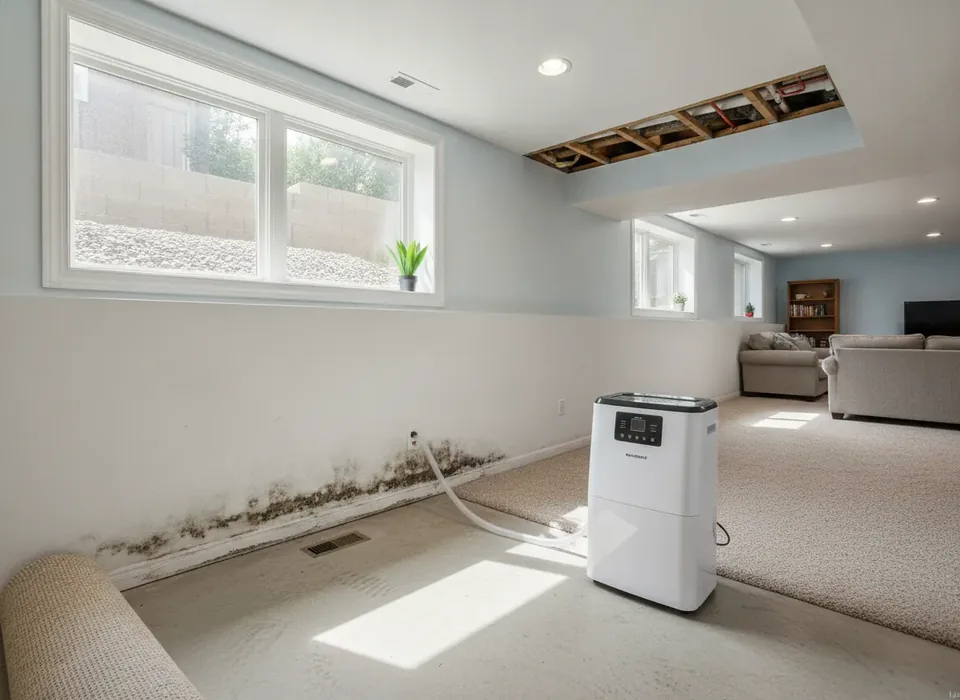
What 1960s–80s ranch homes tend to have
Basements. Many Security and Widefield ranches have full or partial basements, often finished decades ago with paneling and carpet over slab. Seepage from summer cloudbursts, a sump that quits, or a water heater that lets go wets the bottom foot of wall and nobody sees it until it smells. See basement and crawl space mold.
Aging plumbing. Supply and drain lines from the 1970s are at the end of their run. Slow leaks under kitchens and in wall cavities are a common finding, and insurance usually treats a slow leak differently from a burst pipe.
Old swamp coolers. The boxy rooftop evaporative units common in older neighborhoods keep pads wet all summer and can raise indoor humidity. Staining around the duct drop and ceiling is a frequent inspection point. See HVAC, duct and swamp cooler mold.
Drainage. Security Creek and Widefield Creek drain the area and have mapped floodplains. If you are near either, flood is excluded from standard homeowners policies.
Two tests to ask about before tear-out
Asbestos: for a pre-1989 home, ask whether a state-credentialed asbestos building inspector should sample drywall texture, joint compound, flooring or ceiling tile before anything is cut. Colorado Regulation 8 residential trigger levels are 32 square feet, 50 linear feet or a 55-gallon drum. Lead: for a pre-1978 home, paid work that disturbs paint falls under the EPA Renovation, Repair and Painting rule; ask the company for its EPA Lead-Safe firm paperwork. Neither test is needed in every house. Ask, do not assume.
Typical published ranges: basement $1,500–$4,000, HVAC and ducts $3,000–$10,000, and a dated Colorado Springs figure of $9–$19 per square foot (HomeBlue, March 2022). None of these are quotes. Security-Widefield quotes come from the companies; the cost guide explains what moves the number.
Colorado has no state mold license. Ask about IICRC S520 or ACAC training, general liability insurance and a written protocol; we do not verify any of it.
Security-Widefield mold questions
My Security home was built in the 1970s. Do I need an asbestos test before the mold tear-out?
Ask. Drywall texture, joint compound, linoleum and ceiling tile in pre-1989 homes can contain asbestos, and Colorado’s Regulation 8 sets residential trigger levels of 32 square feet, 50 linear feet or a 55-gallon drum of suspect material. A mold tear-out often exceeds that. A state-credentialed asbestos building inspector should sample first; abatement, if needed, is a separate regulated trade. Not every home needs it, so ask the company.
Does the PFAS water issue have anything to do with mold?
No. The Security Water District’s wells were contaminated with PFAS from firefighting foam, and filtration has since been installed. That is a drinking-water quality issue. Mold is a moisture issue: a leaking supply line, a wet basement or a roof breach. The two share nothing except that both prompted a lot of Security-Widefield homeowners to pay closer attention to their houses.
Who do I call about permits in Security-Widefield?
Security-Widefield is unincorporated, so El Paso County rules apply and the Pikes Peak Regional Building Department issues permits. Cleaning or removing moldy finishes usually needs no permit; rebuilding framing, moving plumbing or electrical, or structural demolition does. Confirm with PPRBD, and make sure the company pulling any permit is PPRBD-registered. This is general information, not legal advice.
Nearby areas
Compare options with one short request: get free quotes, browse all service areas, or call Call (719) 642-1761.
Get Security-Widefield quotes
Mention the year your home was built, where the mold is and what got wet. Independent companies that work in Security, Widefield and Stratmoor reply with quotes. Free, no obligation.
Seeing or smelling mold? Get a clear plan.
Free, no-pressure quotes from independent companies across Colorado Springs, Monument, Fountain, Woodland Park and the Pikes Peak region.