
A mold job in a 1970s ranch in Security-Widefield or a 1900s frame house in Manitou Springs often means cutting out drywall, pulling up vinyl flooring or scraping off a textured ceiling. In homes of that age, those materials can contain asbestos, and Colorado regulates how they come out. Asking one question before tear-out starts, "does this need an asbestos test?", can save a health risk, a regulatory problem and a stalled job.
This post explains Colorado's rules in plain terms, which homes are most likely affected, and how the test fits a remediation timeline. Colorado Springs Mold Pros is a free quote service, not a contractor or an asbestos consultant; the rules below are summarized from state sources, not legal advice.
Why mold removal and asbestos collide
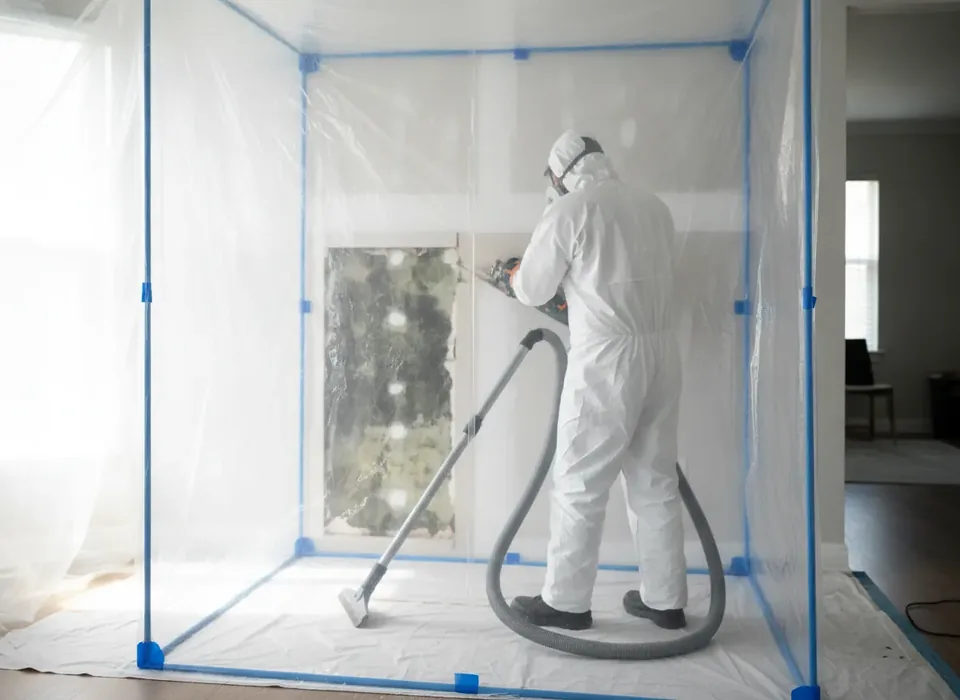
Mold remediation companies remove porous material that cannot be cleaned: drywall, insulation, carpet pad, sometimes ceiling tile and sheet flooring. By the time a company is involved the area is usually well past the EPA's 10-square-foot DIY guideline, and a tear-out often takes a whole wall section or a bathroom floor. Colorado's asbestos rule is written around how much material is disturbed, not whether the job is called renovation or cleanup.
What CDPHE Regulation 8 says
Asbestos in Colorado is regulated by the Air Quality Control Commission's Regulation No. 8, Part B, administered by the Colorado Department of Public Health and Environment (CDPHE). The parts that matter for a mold tear-out in a house:
| Item | Single-family residence |
|---|---|
| Trigger level, surfacing or miscellaneous material | 32 square feet |
| Trigger level, pipe insulation | 50 linear feet |
| Trigger level, by volume | The volume of a 55-gallon drum |
| Who inspects before work that could disturb more than that | A Colorado-certified Asbestos Building Inspector |
| Who removes asbestos above trigger levels | A Colorado-certified General Abatement Contractor (GAC) |
| Notice to CDPHE before abatement | 10 working days |
Summarized from CDPHE Regulation 8, Part B. Public and commercial buildings have different (larger) trigger levels. Confirm current requirements with CDPHE's asbestos program.
Three things follow. First, 32 square feet is small: one 4-by-8 sheet of drywall. A two-foot flood cut along a 16-foot wall is already there. Second, the inspection comes before the disturbance, not after. Third, untested material that could contain asbestos is treated as suspect.
Regulation 8 includes an exemption for buildings built after October 12, 1988, when the architect or engineer certifies in writing that no asbestos-containing materials were used. That paperwork rarely exists for a house, which is why "pre-1989" is the practical cut-off.
The honest version of the rule: an asbestos test is not required for every home. It is required when a job could disturb more than the trigger amounts of material that might contain asbestos, and that is common in older homes. Ask the remediation company, in writing, whether it recommends sampling before tear-out and who will do it.
Which Colorado Springs homes are most likely affected
American Community Survey data (2024 five-year estimates) puts the share of Colorado Springs housing units built before 1980 at roughly 39 percent, and about 36 percent countywide. By decade, the 1970s alone account for about 16.5 percent of the city's housing, and the 1980s another 17 percent, and asbestos-containing joint compound and textures did not disappear overnight in 1980.
Older areas:
- Manitou Springs: median year built 1954, the oldest stock of any incorporated place in the region.
- Westside and Old Colorado City: largely 1890s to 1920s frame homes; plaster, old linoleum and layered flooring are typical.
- Stratmoor: median 1977. Cascade-Chipita Park: median 1970.
- Security-Widefield: median 1981, with much of the stock from the 1960s and 1970s.
Newer subdivisions in Monument (median 2006), Fountain (2000) and Black Forest (1996) rarely raise the question.
Materials that get sampled
An asbestos building inspector takes small bulk samples of each suspect material in the work area. In a typical mold job the suspects are:
- Drywall joint compound and skim coat, and the drywall system as a whole.
- Textured ceilings and walls, including popcorn and knockdown finishes.
- Sheet vinyl and linoleum flooring, the backing and the mastic beneath it.
- Ceiling tiles and the adhesive behind them.
- Pipe and duct insulation in basements and crawl spaces.
- Plaster in pre-1950s homes.
Concrete, wood, brick and steel are not asbestos materials, so a crawl space with bare joists usually needs no sampling even in an old house. A finished basement with a textured ceiling in the same house does.
How the test fits into a mold job's timeline
Contain and stop the water first
Containment, shutting off the leak and HEPA filtration do not disturb materials, so they can start right away while sampling runs. That matters on rental units, where Colorado's 72-hour rule puts these steps on a clock.
Sampling and lab results
A certified inspector samples the materials in the planned tear-out area. Turnaround depends on the lab.
Negative results
The remediation company proceeds with tear-out as planned. Keep the lab report; it is useful if you sell the house or file an insurance claim.
Positive results above trigger levels
A certified General Abatement Contractor removes the asbestos-containing material under its own containment after filing notice with CDPHE, with a 10-working-day notice period. Some remediation companies hold both qualifications; others bring in an abatement firm. Mold work on the remaining materials follows.
Lead paint: the other pre-1978 question
If the home was built before 1978 and the work will disturb painted surfaces, the EPA's Renovation, Repair and Painting (RRP) rule applies. Colorado is not an EPA-authorized state program, so the EPA administers RRP here directly. Paid work that disturbs paint in a pre-1978 home has to be done by an EPA Lead-Safe Certified firm using trained renovators and lead-safe practices. Roughly 23 percent of Colorado Springs units predate 1970, so this comes up regularly on the Westside, in Manitou Springs and in the Old North End. Ask for the firm's EPA Lead-Safe certificate alongside the asbestos question.
What it means for your budget
The ranges on our mold remediation cost guide are for the mold work itself. They exclude asbestos and lead testing and any abatement, and so does the calculator on that page. Sampling adds a modest line item; abatement, if it is needed, is a separate job with its own quote. Ask every company to break those lines out so you can compare quotes fairly.
Permits are a separate question: removing and cleaning finishes usually needs no Pikes Peak Regional Building Department permit, but rebuilding framing, moving plumbing or electrical, or structural demolition does. Confirm with PPRBD; the company pulling the permit must be PPRBD-registered.
Questions to ask before tear-out
- Will the tear-out disturb more than 32 square feet of drywall, texture, flooring or ceiling material?
- Do you recommend asbestos sampling for this home, and will a Colorado-certified asbestos building inspector take the samples?
- If results come back positive, who does the abatement, and how does the 10-working-day notice affect my schedule?
- Can the quote separate mold remediation from any asbestos or lead work?
Colorado has no state license for mold remediation itself, so the asbestos and lead credentials are among the few things a homeowner can verify directly: CDPHE and the EPA each keep public lists.
Frequently asked questions
Is an asbestos test required before mold removal in Colorado?
Not for every home. CDPHE Regulation 8 requires inspection by a Colorado-certified asbestos building inspector before renovation or demolition that could disturb more than the trigger amounts of suspect material: 32 square feet of surface material, 50 linear feet of pipe insulation or a 55-gallon drum's worth, for a single-family home. Many mold tear-outs in pre-1989 homes cross that line, so ask the company whether a test is needed.
What materials in a Colorado Springs home might contain asbestos?
Common suspects are drywall joint compound and textured ceilings or walls, sheet vinyl and linoleum flooring and the adhesive under it, ceiling tiles, pipe and duct insulation, and some older roofing and siding. Bare concrete, wood, brick and steel are not asbestos materials. Only a lab test tells you whether a specific material contains it.
How long does asbestos abatement add to a mold job?
If suspect material tests positive above the trigger levels, removal must be done by a Colorado-certified General Abatement Contractor who files a notice with CDPHE, and the notice period is 10 working days before work starts. Add the sampling turnaround on top of that. Companies can usually contain the area and stop the water while that runs.
Does lead paint matter too?
In homes built before 1978, paid work that disturbs paint falls under the EPA's Renovation, Repair and Painting rule, which the EPA administers directly in Colorado. The company should be an EPA Lead-Safe Certified firm and use lead-safe work practices. Ask for the certificate if the mold is behind painted plaster or trim in an older home.
Get quotes that answer the asbestos question up front
Tell the companies the age of your home when you request free quotes, and ask each one whether it recommends sampling before tear-out. Independent local companies reply directly; there is no obligation. Call Call (719) 642-1761 if you would rather talk it through.