
Search for mold help in Colorado Springs and you will see no-charge inspection offers from remediation companies next to independent testing firms charging several hundred dollars. It is reasonable to wonder which one you need, or whether you need either. The answer depends on one question: can you already see the mold?
This guide explains the difference, what the EPA says about sampling, when testing earns its fee, what it costs, and why it matters who does it. Colorado Springs Mold Pros is a free quote service that connects homeowners with independent local inspection and remediation companies. We do not inspect or test anything; the companies do. This site offers free quotes, not inspections.
Inspection and testing are two different jobs
People use the words interchangeably. They are not the same.
| Mold inspection | Mold testing | |
|---|---|---|
| What it is | A visual and moisture survey of the home | Air, surface or bulk samples analyzed by a lab |
| What it answers | Where is the mold, how far does it go, what is feeding it? | What is in the air or on this surface, and how much? |
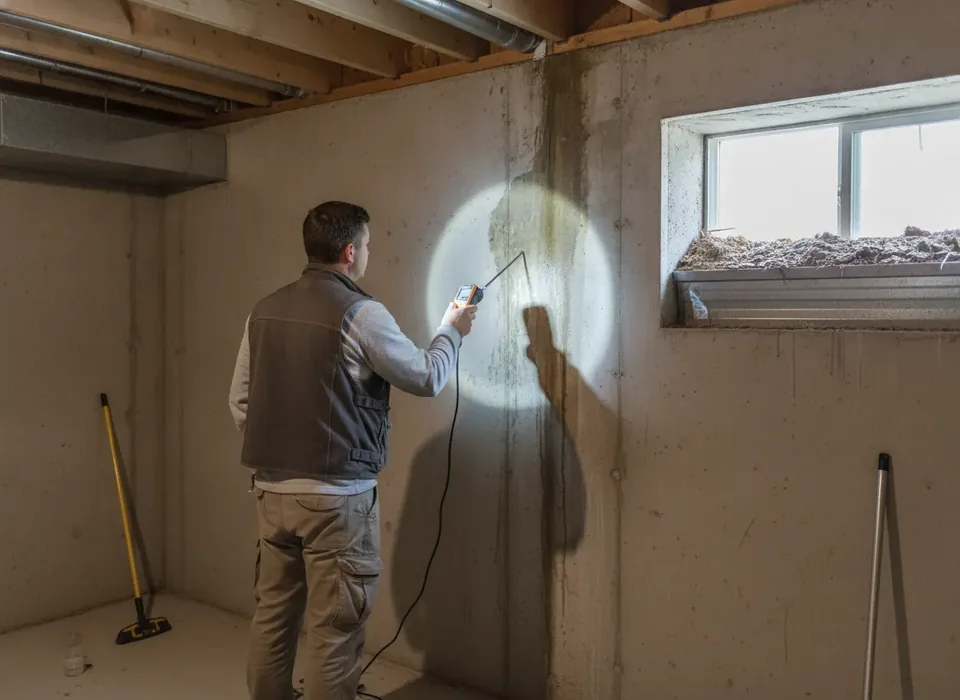
| Tools | Flashlight, moisture meter, sometimes a thermal camera and borescope | Spore-trap cassettes, tape lifts, swabs, bulk cuttings |
| Output | A written report with photos and a recommended scope | A lab report with spore counts or species, usually in a few business days |
| Typical fee (national, 2025) | $303–$1,044 combined, avg about $670 (HomeAdvisor); air-sample lab fees $250–$350 | |
Typical published ranges, not quotes. Colorado Springs quotes come from the companies, not from this site.
Most independent inspectors offer both and will say when sampling is not worth paying for. A visit commonly takes a couple of hours; lab turnaround is often a few business days.
What the EPA says about testing
The EPA's guidance is direct: "In most cases, if visible mold growth is present, sampling is unnecessary." There are no federal limits for mold spores in a house, so a lab number cannot tell you whether a home is safe. What matters is finding the moisture and removing the growth.
If you can see mold spreading up a basement wall below a window well, a $600 air test will confirm there is mold in the air near a wall with mold on it. The money is better spent on the seepage and the wall.
A quick self-check. If you can point to the mold and you know roughly what got it wet, you are usually ready for remediation quotes, not a test. If you can smell it but cannot find it, or someone else needs a document, keep reading.
When testing actually helps
Sampling has real uses. It is worth paying for when:
- Mold is suspected but hidden. A musty smell with nothing visible, or a past leak behind a finished wall. Air samples compared against an outdoor control can show elevated indoor counts and point to the cavity worth opening.
- Someone else needs documentation. A landlord dispute, a home sale, a daycare or home-business license, or an insurance claim. In a rental, Colorado's habitability statute specifically lists post-remediation testing among the landlord's duties; see our 72-hour rule post.
- Clearance after remediation. Verification that the work area is dry, clean and back to background levels before containment comes down and the wall is rebuilt. This is the most useful test in the whole process.
- A doctor asks for it. That is a medical decision, and the results go to the doctor. This site makes no health claims.
- The mold keeps coming back. Repeated growth after cleaning means a moisture source nobody has found. An inspection with moisture mapping, more than a test, solves this.
Types of mold samples
- Air (spore trap): a pump pulls a measured volume of air through a cassette; the lab counts spores. One outdoor control plus two to four indoor samples is a common protocol. This is what "air quality testing" usually means for mold.
- Surface (tape lift or swab): confirms a stain is mold and which kind.
- Bulk: a piece of the material itself. Rare for mold, standard for asbestos, which is a different test by a different inspector; if the house predates 1989, read our post on asbestos testing before tear-out.
Hardware-store petri-dish kits nearly always grow something, because spores are everywhere. Without an outdoor comparison and someone to interpret the result, they rarely change what you should do.
Why the Colorado Springs angle matters
Colorado Springs is semi-arid, roughly 16 inches of precipitation a year, so mold here is almost always a local moisture event. It hides where water gets trapped: wall cavities after a frozen-pipe burst, floors over a damp crawl space, attic decking under a hail-damaged roof, swamp coolers and their ducts. Ask whether the inspector will check the attic, the basement or crawl space, the swamp cooler and any furnace humidifier, not just the room with the stain.
Should the inspector also be the remediator?
This is the question that matters most. Colorado does not license mold inspectors or mold remediation companies, so anyone can hold either title, and the checks you build in yourself are the main safeguard.
The cleanest arrangement separates the roles:
An independent inspector finds and scopes the problem
They write a report and a recommended protocol. They do not sell the fix.
Remediation companies quote against that scope
Several quotes on one written scope are easy to compare. Five self-generated scopes are not.
The same independent inspector does the clearance
Post-remediation sampling by someone with no stake in the result tells you the work is done.
That is not the only honest model. Many remediation companies do their own moisture mapping and visual look as part of a quote, which is reasonable. The thing to be careful about is a no-charge visit that comes with a sample result from the same company and a large remediation proposal the same afternoon. Ask who ran the lab analysis and whether an independent clearance test is included.
Whoever you hire, ask about IICRC S520 or ACAC training, general liability insurance and a written protocol. None of that is a state license, because there is none, but it is what you can check.
What it costs, and how it compares to remediation
Using the published national figures: a combined inspection and testing visit runs roughly $303 to $1,044, with lab fees for air samples typically $250 to $350. Post-remediation clearance testing is often an extra $250 to $700 in lab fees and air samples, as an estimate. Remediation itself typically runs $10 to $25 per square foot, or $1,500 to $9,000 for a whole job. The Colorado Springs mold remediation cost guide has the full table and a calculator that lets you add inspection and clearance line items.
On a small, visible problem, testing can cost as much as the fix. On a hidden problem or a rental dispute, it is the cheapest part of the job and the part most likely to keep you from paying for work you do not need. The mold inspection and testing page covers what a visit looks like.
Frequently asked questions
Do I need a mold test if I can already see mold?
Usually not. The EPA says that in most cases, if visible mold growth is present, sampling is unnecessary. What you need is to find and stop the moisture source and remove the growth. Testing helps when mold is suspected but hidden, when a landlord, insurer or buyer wants documentation, or after remediation to confirm the area is clear.
What is the difference between a mold inspection and mold testing?
An inspection is a visual and moisture survey of the home: where the mold is, how far it extends and what is feeding it, often using a moisture meter and sometimes a thermal camera. Testing means collecting air, surface or bulk samples and sending them to a lab. Many inspectors offer both; the inspection is the part that finds the problem, the testing is the part that measures it.
How much does a mold inspection cost in Colorado Springs?
HomeAdvisor's 2025 national figures put inspection and testing at about $303 to $1,044, averaging around $670, with air-sample lab fees typically $250 to $350 on top. Colorado Springs quotes come from the companies, not from this site. A visual inspection with no samples is at the low end; several air samples with an outdoor control push toward the high end.
Should the company that tests also do the remediation?
It is cleaner if they do not. A company that profits from the remediation has an incentive to find more of it, and the same company grading its own clearance test is not an independent check. Colorado has no state mold license for either role, so independence is one of the few safeguards you control. Ask whether the inspector sells remediation, and who will do the post-remediation sampling.
Get quotes for inspection, testing or remediation
Describe what you see or smell and where, and request free quotes from independent local inspection and remediation companies. If you want an independent inspector first, say so in the details. No obligation. You can also call Call (719) 642-1761.