
Attic mold in Colorado Springs rarely announces itself. There is no humid summer to feed it. What there is instead: 32 inches of snow a year, strong high-altitude sun, hailstorms that bruise roofs across whole neighborhoods, and more than a few bath fans never ducted outside. Each puts water on roof decking unnoticed until a ceiling stain appears, or a buyer's inspector opens the hatch during a sale.
This post covers the three local causes, how to tell which you have, what a remediation company does in an attic, and where the roof repair fits. Colorado Springs Mold Pros is a free quote service that connects homeowners with independent local mold companies. We do not arrange roofing work; that is a separate contractor and a separate quote.
Cause one: the ice-dam cycle
Ice dams need snow on the roof, heat loss into the attic, and cold eaves. The Front Range supplies all three.
Snow lands and sits
Colorado Springs averages about 32.5 inches of snow a year; March is the snowiest month in the 1991–2020 normals, and spring snow is often heavy and wet.
The attic warms the roof from below
Gaps around can lights, the hatch and duct penetrations, plus thin insulation, let house heat into the attic. The deck warms above freezing and melts the snow touching it. At 6,000 feet, daytime sun helps even when the air is below freezing.
Meltwater refreezes at the eaves
The overhang has no warm attic beneath it, so water freezes into a ridge there. Water behind the ridge pools, backs up under the shingles and soaks the decking, the soffit and the top of the exterior wall.
Repeat every night
Sunny days and freezing nights keep the cycle going for weeks. When the attic warms in spring, mold grows on the wet wood.
Where it shows: dark staining on the decking along the eaves, especially north and shaded sides, wet insulation at the attic edges, and ceiling stains along exterior walls. Monument, Woodland Park and Black Forest, with far more snow than the city, see it more.
The lasting fix is air-sealing the attic floor, adding insulation and making sure soffit and ridge vents move air, so the deck stays cold. A remediation company cleans the decking; an insulation contractor stops the dam from forming again.
Cause two: hail-damaged roofs that leak slowly
Colorado Springs is in a hail belt. The July 28, 2016 storm produced about $352.8 million in insured losses from 84,500 claims, the city's second most costly catastrophe after the Waldo Canyon Fire. The August 6, 2018 storm dropped softball-size hail on the southwest side and Fountain, roughly $172.8 million in damage in Colorado Springs alone.
The roofs that failed outright got replaced. The ones that matter for mold were merely bruised: shingle seals cracked, flashing lifted, a vent boot split. Those leak a little with each storm, often into the decking rather than through the ceiling, and roofs patched or never inspected after 2016 and 2018 have had years for that to work.
Where it shows: isolated dark patches that do not line up with the eaves, often below a vent, a valley or a repair, and ceiling stains that appear after a summer storm rather than in spring.
The roof comes first, and it is a separate job. Cleaning an attic under a roof that still leaks wastes your money. Have a roofing contractor find and fix the leak, or at least tarp it, before the attic is treated. Roofing repairs under 100 square feet are on the Pikes Peak Regional Building Department's no-permit list; larger work needs a permit pulled by a PPRBD-registered roofer. We do not arrange roofing work.
Cause three: bath fans that vent into the attic
In a dry climate this may be the most common attic mold cause of all. A bathroom exhaust fan is supposed to carry moist air outdoors through a duct to the roof or a gable. In many homes the duct ends in the attic, either installed that way or pulled off the roof jack years ago.
Every shower then dumps warm, wet air onto cold decking a few feet from the fan. In winter it frosts on the nails and sheathing, then melts and soaks in. A few years of that leaves a dark circle of growth above the bathroom, with the rest of the attic clean. Dryer vents ending in the attic and furnace humidifiers set too high do the same; HVAC sources put the winter indoor target around 30 to 40 percent humidity.
The fix is an insulated duct run to the outside, a handyman or HVAC job done before or alongside the cleanup.
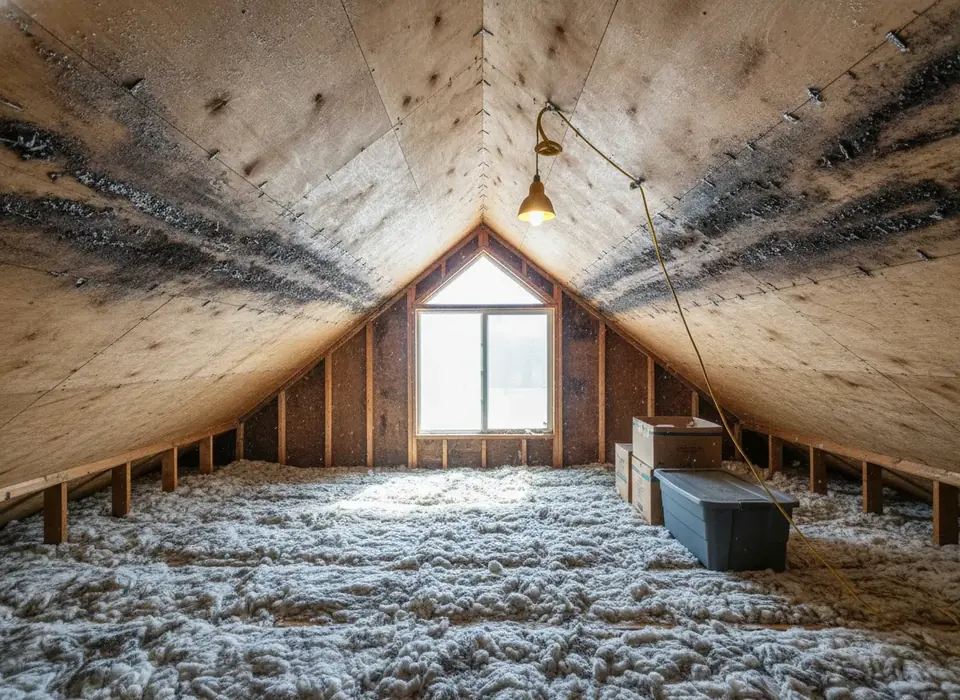
How to tell which problem you have
| What you see | Most likely cause | Who fixes the source |
|---|---|---|
| Staining along the eaves, worse on shaded sides; icicles every winter | Ice dams | Insulation contractor (air-sealing, insulation, ventilation) |
| Isolated patch below a vent, valley or repair; stains after summer storms | Roof leak, often hail-related | Roofing contractor |
| Dark circle above a bathroom or laundry; duct ends in the attic | Fan or dryer venting into the attic | Handyman or HVAC contractor |
A remediation company's visit usually starts with this sorting. If the source is unclear, see when a mold inspection or test helps.
What a remediation company does in an attic
A typical scope:
- Moisture mapping of decking and insulation; the wet area is usually larger than the stain.
- Containment and HEPA filtration at the hatch so dust stays out of the living space.
- Removing wet insulation. Soaked blown insulation rarely dries in place.
- Cleaning the decking. Sheathing is structural and is generally cleaned rather than replaced: HEPA vacuuming, then media blasting, sanding or antimicrobial treatment depending on the protocol. Rafters get the same.
- Drying until the wood reads normal, then clearance, visual and, if you want it, by sampling.
- Replacement insulation and duct or ventilation corrections, by the remediation company or a separate contractor.
Badly rotted decking is a roofer's job. The mold remediation process page has the general steps; the roof leak and attic mold page covers the attic version.
What attic mold remediation costs
This Old House's 2026 figures put attic mold remediation at $1,000 to $4,000, inside the general $10 to $25 per square foot range; attics run high per square foot because of access and insulation removal. The full table and a calculator are on the mold remediation cost guide. Roof repair, insulation and duct work are separate quotes and are not in those figures.
In homes built before 1989, ask whether an asbestos test is needed if the work will disturb ceiling texture or old insulation; our asbestos post explains the trigger levels. Vermiculite attic insulation should not be disturbed without testing.
Before you hire, ask whether the moisture source is confirmed and the roof or duct fix scheduled first, whether insulation replacement is in the quote, how the decking will be cleaned, and about IICRC S520 or ACAC training, general liability insurance and a written protocol. Colorado has no state mold license, so those questions are the vetting. The companies are independent; we do not verify their answers.
Frequently asked questions
How do ice dams cause attic mold in Colorado Springs?
Heat escaping into the attic melts the underside of the snow on the roof. The meltwater runs down to the cold eaves and refreezes into a ridge of ice. Water pooling behind that ridge backs up under the shingles and into the roof decking, insulation and ceiling below. Each sunny day and freezing night repeats the cycle, and the wet decking grows mold once temperatures rise.
Can a hail-damaged roof cause mold months later?
Yes. Hail that bruises shingles, cracks seals or lifts flashing often leaks slowly rather than all at once. Water wets the decking a little with each storm, and the stain or mold shows up on the ceiling or in the attic months after the hailstorm. The 2016 and 2018 storms in Colorado Springs left many roofs with this kind of damage.
Why does my bathroom fan vent into the attic, and does it matter?
Some builders and remodelers ran bath fan ducts into the attic instead of through the roof or a gable, or the duct came loose over time. Every shower then pumps warm, wet air onto cold roof decking. It is one of the most common causes of attic mold in a dry climate and usually shows as a dark patch near where the duct ends. The fix is to run the duct outdoors.
Who fixes the roof if the attic has mold from a leak?
A roofing contractor repairs the roof; a mold remediation company handles the attic. They are separate trades and usually separate quotes. The companies we connect you with do mold work. Arrange the roof repair yourself with a roofer, and have it done, or at least tarped, before the attic is cleaned so the problem does not come back.
Get quotes for attic mold cleanup
Request free quotes from independent local remediation companies and mention what you see on the decking, when the stains appeared and whether the roof has been checked. Companies reply directly; no obligation. Or call Call (719) 642-1761. Roof repair is arranged separately with a roofing contractor.